News

Monocrystalline vs. Polycrystalline: Which Solar Panel is Right for Your Home?

  • Category:
  • Browse number: ...
  • Release time: 2026-05-18

1. Monocrystalline Solar Panels: The Premium Choice

How they are made: Monocrystalline panels are made from a single, pure silicon crystal. The silicon is grown into bars and then sliced into wafers. You can easily recognize them by their dark black color and rounded edges.

The Pros:

  • Highest Efficiency: These panels have the highest conversion rates (typically 17% to 22%). This means they generate more power in a smaller space.
  • Space Saving: Because they are efficient, you need a smaller panel to charge a large battery. This is why our high-end Integrated 4G Cameras often use monocrystalline panels.
  • Durability: They tend to last the longest, often performing at high capacity for over 25 years.
  • Heat Tolerance: They perform better in hot climates (like Vietnam or the Middle East) compared to polycrystalline alternatives.

The Cons:

  • Higher Cost: The manufacturing process is more complex, making them more expensive upfront.


2. Polycrystalline Solar Panels: The Economic Workhorse

How they are made: Instead of a single crystal, polycrystalline panels are made by melting fragments of silicon together. This results in a distinctive blue hue and a "shattered glass" look on the surface.

The Pros:

  • Lower Price: The manufacturing process is simpler and results in less waste, making these panels more affordable.
  • Good Value for Large Areas: If you have plenty of space and a limited budget, polycrystalline is a solid choice for simple garden lights or street lighting.

The Cons:

  • Lower Efficiency: Conversion rates are usually between 13% and 16%. You will need a larger physical panel to get the same power output as a monocrystalline one.
  • Sensitivity to Heat: They don't perform quite as well in extremely high temperatures, which can shorten their lifespan slightly.


3. The Comparison: Head-to-Head

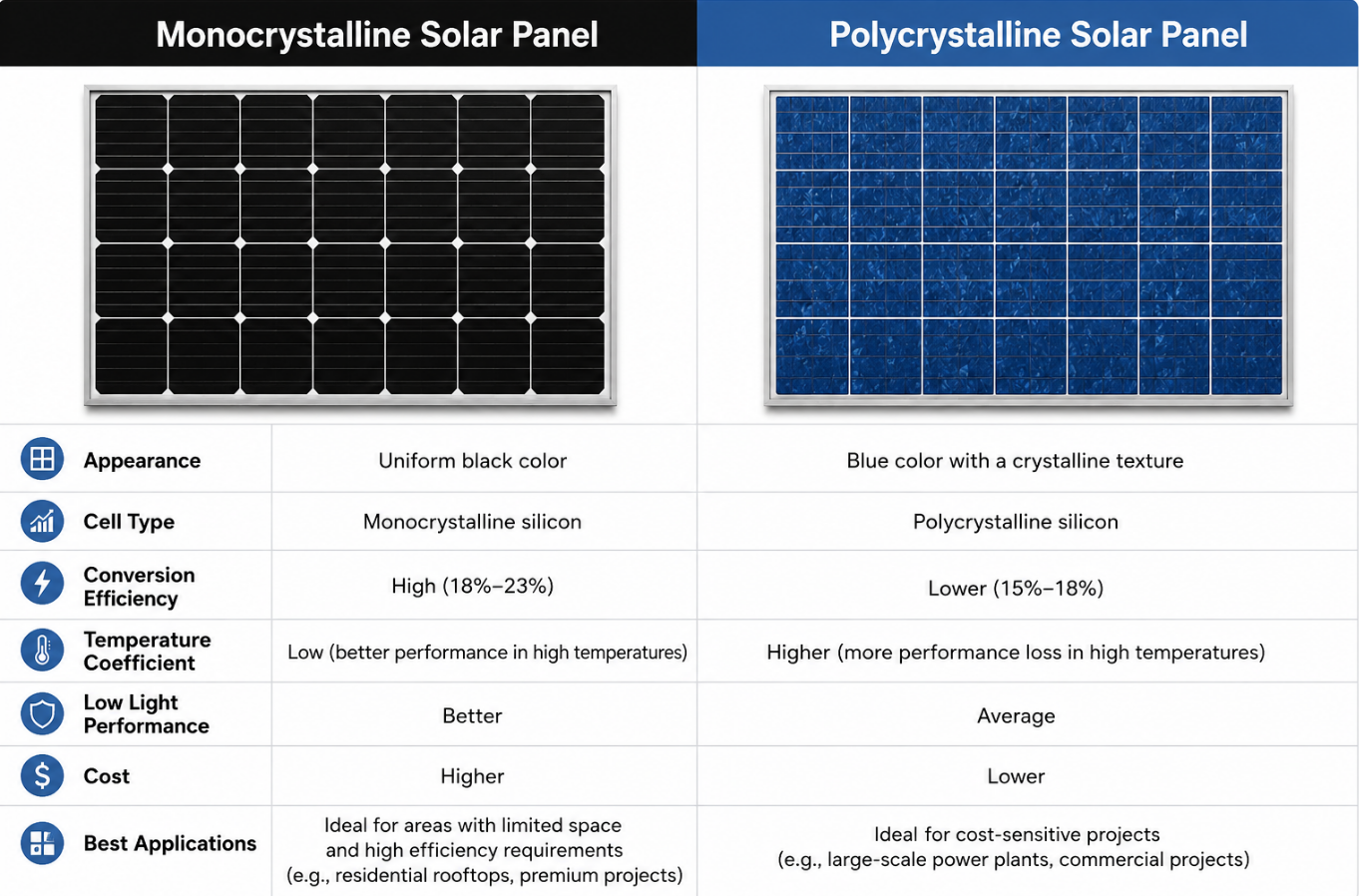
Feature Monocrystalline (Premium) Polycrystalline (Economy)
Appearance Pure Black, Rounded Edges Blue, Square Edges
Efficiency High (17-22%) Moderate (13-16%)
Cost Higher Lower
Performance in Heat Excellent Average
Best For Limited space, high-performance tech Large projects, budget-conscious


Comparison images of monocrystalline and polycrystalline silicon photovoltaic panels

4. Which One Should You Choose for Your Leinis Products?

Choose Monocrystalline if:

  • You are buying a 4G Surveillance Camera or High-Wattage Fan. These devices need maximum energy quickly.
  • You live in an area with limited daily sunlight hours.
  • You want the absolute longest lifespan and most professional look (Black panels look much sleeker on modern homes).

Choose Polycrystalline if:

  • You are buying Basic Solar Street Lights for a large property or village project.
  • You are on a tight budget but still need reliable off-grid lighting.
  • You have plenty of space to mount larger panels.

Conclusion: Quality Always Wins

At Leinis (LAS), we prioritize performance. That’s why the majority of our 2026 collection, including the LNS-137 and AT8 series, comes standard with High-Efficiency Monocrystalline Panels. We believe that saving a few dollars on a cheaper panel isn't worth losing hours of light at night.

Ready to upgrade to premium solar power?

Browse our Monocrystalline Collection

Have more technical questions? Contact our engineers via WhatsApp: +86 13686910669


url: https://www.leinispro.com/news/175.html

CONTACT US

Phone: +86 13360444441
WhatsApp: +86 13686910669
Email: liangnu79@gmail.com

Add:233 Jin'ou Road, Jianghai District, Jiangmen City, Guangdong Province

Copyright © 2026 Guangdong Meijia Meifu Technology Co., Ltd. All Rights Reserved

Quick contact

online service

Hello, I am the online customer service

X